
Research
A Roadmap to Greening the Solar System
‘Terraforming’ means different things to different people
Technical feasibility is not the only consideration for terraforming. Cultural priorities and ethical boundaries also shape our vision for the desired endpoint. The idea of bringing life to other worlds has captured the imagination of many scientists and thinkers, from Konstantin Tsiolkovsky in the 1890s to Carl Sagan and other visionaries in the 20th century. If we decide in the future to bring life to other worlds, it is agreed that Mars is the first place to look and that warming Mars would be the first step in making the surface suitable for life.
How might humans terraform Mars?
Near term
Today Mars is too cold and dry for Earth-like life to flourish. The first step is abiotic engineering to heat the planet.

Method: Abiotic engineering Goal: temperature
Mid term
Method: Photosynthesis Goal: oxygen levels
Long term
In the long term, Mars would accumulate more atmosphere and have a stable, favourable climate.

Method: Abiotic + biotic Goal: pressure, stabilize climate
There are many possible visions for Mars’s future
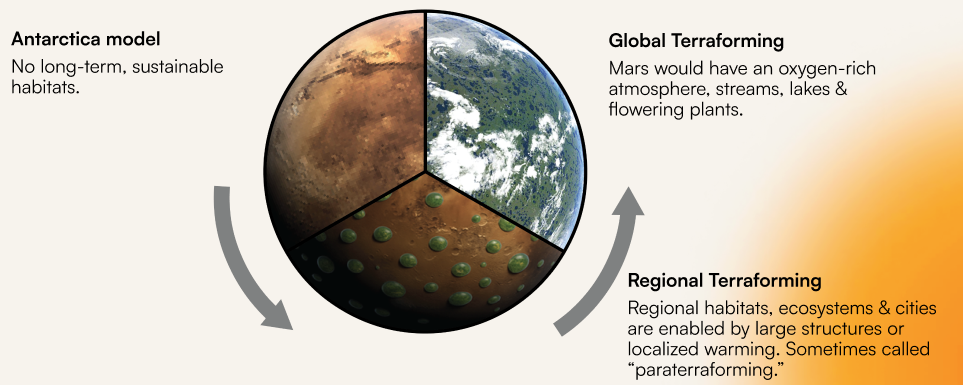
Creating sustainable habitats and ecosystems beyond Earth can be approached in (at least) three ways. These visions are largely sequential, i.e. local terraforming would likely precede global terraforming.
What might a globally terraformed Mars look like?
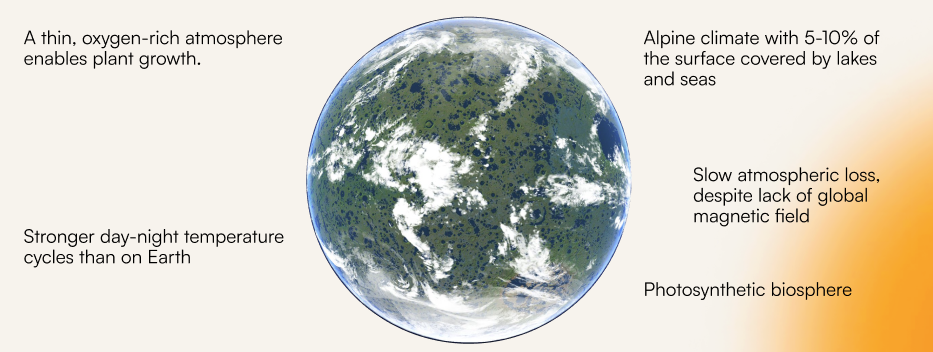
This vision of a globally terraformed Mars uses local atmosphere, water, and regolith to build a thin but breathable climate, stable ecosystems, and a habitable surface without importing materials from off-planet. One possible end point would have no magnetic field, a global average temperature of -5°C and an atmosphere with sufficient oxygen to support plants and minor N₂. If geochemically possible, this endpoint could likely be achieved over many centuries without major new spaceflight capabilities beyond the current era of large reusable launch vehicles.
What is different about a Green Mars?
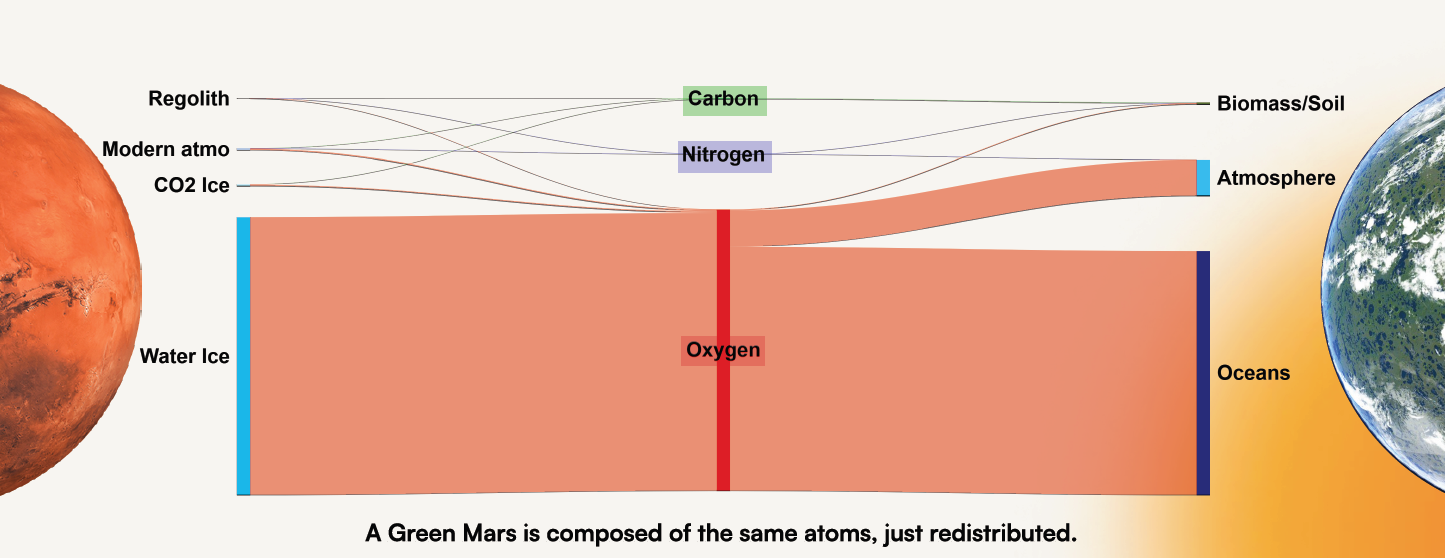
Two major changes would transform the planet. 1) warming melts at least some ice and 2) photosynthesis converts some of the former ice into an oxygen-rich atmosphere. This assumes that Mars has enough electron acceptors to serve as a hydrogen sink for photosynthesis.
Existing raw materials include: regolith, atmosphere, CO₂ ice cap and ice.
How could we create a planetary-scale biosphere?
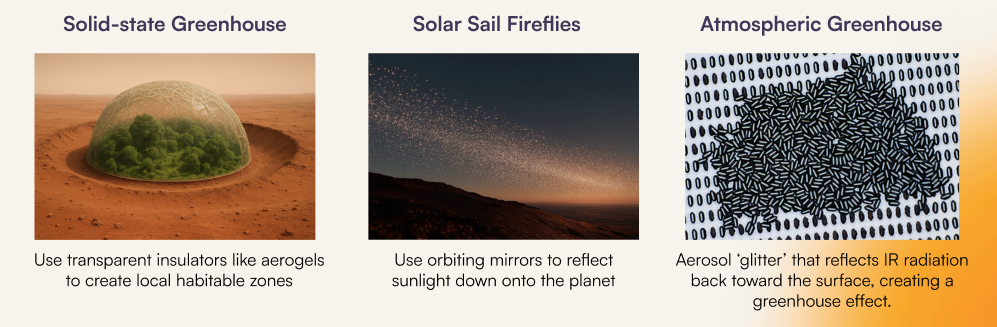
Many microbes and some plants can grow at low pressure, making temperature a more serious barrier to plant growth. A combination of approaches could be used to create habitats at scale that are warm enough for photosynthetic organisms. Crucially, a warmer Mars could enable liquid water even at low atmospheric pressure and CO2 would outgas on a warmed Mars.
There are several potentially effective ways to warm Mars. Materials that are transparent and insulating like silica aerogels and cellulose aerogels can be used to create greenhouses. Engineered aerosol can be used to reflect IR radiation back toward the surface. Solar sails can reflect sunlight down to the surface.
Meaningful warming could be achieved quickly. The global average temperature could be increased 30°C in 30 years, enough to enable photosynthesis outside. This plant cover would generate enough oxygen to fill a dome habitat in ~2 years, and accumulate a planetary scale atmosphere over a much longer timescale (centuries at least).
If you want to read more, you can find the Introduction to Mars Terraforming arXiv post at this link.
Terraforming research offers new approaches to key research questions:
Research Spotlight
Particle screening tool
The Screening Tool provides a streamlined way to compare how different particles interact with the electromagnetic radiation at Mars and calculate their average warming effects on the surface.